Cloud POS vs. Traditional POS: Which System Is Better for Your Business?
- Next Level POS
- Aug 13
- 6 min read

Choosing between a cloud POS system and a traditional POS system is an important technology decision for restaurants and retail businesses. Both systems can process sales and manage day-to-day operations, but they differ significantly in how data is stored, how businesses access information, how updates are handled, and how easily the system can grow.
Below, Next Level POS answers common questions business owners ask when comparing cloud-based and traditional point-of-sale systems.
What Is a Cloud POS System?
A cloud POS system is a point-of-sale system that uses internet-connected software and cloud technology to manage business information.
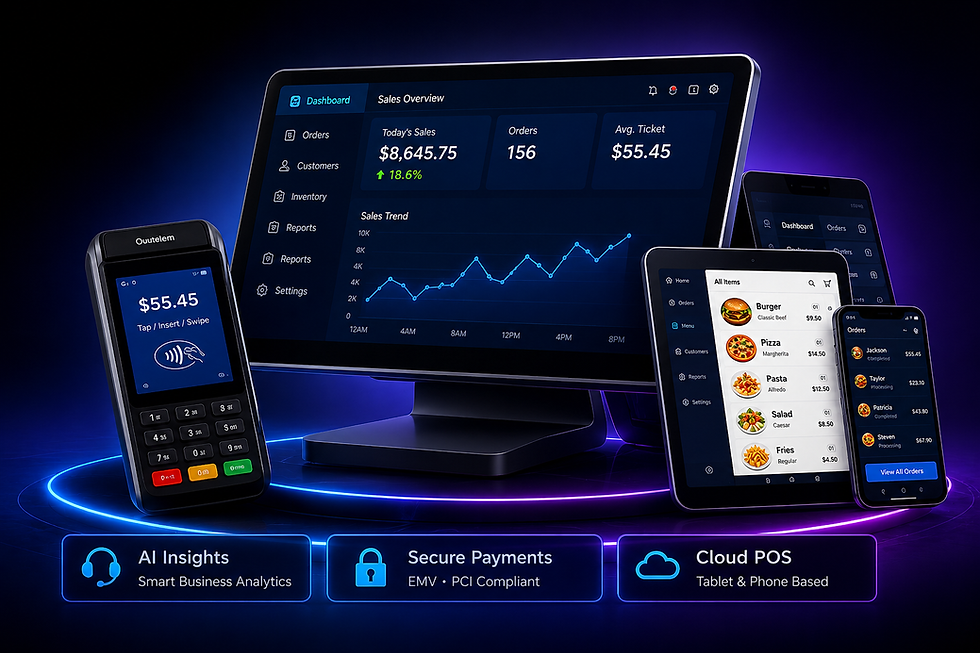
Depending on the platform, authorized owners and managers may be able to access sales reports, business data, inventory information, employee activity, and other POS functions remotely from compatible devices.
Cloud POS systems are commonly used by restaurants, retail stores, coffee shops, bars, and multi-location businesses.
What Is a Traditional POS System?
A traditional POS system, sometimes called an on-premise or locally hosted POS system, generally stores much of its software and business data on computers or servers located at the business.
Traditional POS systems have been used successfully for decades and can still be appropriate for certain businesses.
However, they may require more local infrastructure, manual software maintenance, local backups, and on-site technical support than modern cloud-based platforms.
What Is the Main Difference Between Cloud POS and Traditional POS?
The biggest difference is where the POS software and business information are managed and how they can be accessed.
With a traditional POS environment, much of the system operates from equipment located inside the business.
With a cloud POS system, important information is synchronized with cloud-based services, allowing the business to take advantage of remote access and centralized management features supported by the POS provider.
This can make cloud POS especially attractive to owners who want greater flexibility and visibility into their operations.
Can I Access a Cloud POS System From Outside My Business?
One of the major advantages of many cloud POS platforms is remote access.
Depending on the software and permissions, an owner or manager may be able to review business information without physically being at the restaurant or store.
For example, a business owner may be able to check:
Daily sales
Transaction reports
Employee activity
Inventory information
Product performance
Labor information
Multi-location performance
Business analytics
Available features vary by POS platform and configuration.
Does a Cloud POS System Need Internet Access?
Cloud POS systems rely on internet connectivity for cloud communication, synchronization, online services, and many integrations.
However, some modern POS platforms provide limited offline capabilities that allow certain operations to continue temporarily if the internet connection is interrupted.
Offline capabilities vary significantly between systems, so businesses should ask exactly what happens when internet service goes down before choosing a platform.
A professionally designed business network and reliable internet connection remain important parts of a cloud POS installation.
Why Is Business Networking Important for Cloud POS?
A cloud POS system is only one part of the technology environment.
POS terminals, payment devices, kitchen printers, receipt printers, Kitchen Display Systems, handheld devices, routers, switches, Wi-Fi, and internet connections may all need to communicate reliably.
Poor networking can cause problems that appear to be POS problems even when the POS software itself is operating correctly.
That is why Next Level POS considers business networking and POS installation together when designing a turnkey solution.
Is Cloud POS Better for Restaurants?
Cloud POS can provide significant advantages for many restaurants.
A properly configured restaurant POS environment can connect front-of-house and back-of-house technology, including:
Touchscreen POS terminals
Handheld ordering devices
Kitchen Display Systems
Kitchen printers
Online ordering
Payment processing
Gift cards and loyalty
Employee management
Sales reporting
Menu management
The best configuration depends on the restaurant's size, service model, menu, workflow, number of terminals, and locations.
Is Cloud POS Good for Retail Stores?
Yes. Cloud POS systems can also work well for retail businesses.
Depending on the platform, retailers may use cloud POS technology for:
Checkout
Barcode scanning
Inventory management
Customer management
Employee management
Payment processing
Sales reporting
Product management
Multi-location reporting
A retailer should choose a system based on its actual operational requirements rather than simply choosing a POS because it is labeled “cloud-based.”
Is Cloud POS Better for Multiple Locations?
Cloud technology can be especially useful for businesses operating multiple locations.
Instead of treating every location as an isolated POS environment, supported cloud platforms may provide centralized reporting and management tools.
An owner may be able to compare locations, monitor sales, manage products or menus, review employee activity, and access business information from a central account.
The exact multi-location capabilities depend on the POS software selected.
Are Cloud POS Systems Automatically Updated?
Many cloud POS providers can deploy software updates centrally instead of requiring businesses to manually install every update on a local server.
This can simplify software maintenance and allow new features, security improvements, and fixes to be delivered more efficiently.
However, update policies vary between POS providers, so merchants should understand how their specific system handles updates and maintenance.
Is Cloud POS More Secure Than Traditional POS?
Neither cloud nor traditional POS technology is automatically secure simply because of how it is hosted.
Security depends on the complete environment, including the POS provider, payment technology, network configuration, passwords, user permissions, software maintenance, and business practices.
Modern cloud platforms can provide advantages such as centralized security updates, managed infrastructure, controlled user access, and cloud backups.
Businesses should still use strong security practices and properly configured networks.
Can Cloud POS Integrate With Payment Processing?
Yes. Many modern cloud POS systems support integrated payment processing.
An integrated setup allows the POS and payment terminal to communicate directly, reducing the need to manually enter transaction amounts into a separate credit card terminal.
Depending on the solution, integrated payments can help simplify checkout, improve reporting, and reduce manual entry errors.
Next Level POS provides both POS solutions and payment processing, allowing qualifying businesses to build a more connected technology environment.
Can Cloud POS Work With Online Ordering?
Many cloud POS platforms can integrate with online ordering systems.
When properly configured, online orders may flow directly into the restaurant's POS or kitchen workflow instead of requiring employees to manually re-enter orders.
This can help reduce duplicate work and ordering mistakes while giving customers another convenient way to purchase.
Integration capabilities depend on the POS and online ordering platforms being used.
Does Switching to Cloud POS Mean Replacing All My Hardware?
Not necessarily.
Whether existing equipment can be reused depends on the POS platform and the compatibility of the current hardware.
Existing printers, cash drawers, payment terminals, barcode scanners, network equipment, and computers may or may not work with a new system.
Before replacing equipment, Next Level POS can evaluate the existing environment and determine what can reasonably be retained and what should be upgraded.
Is Cloud POS More Expensive Than Traditional POS?
There is no single answer because POS pricing depends on the software, hardware, number of terminals, payment processing arrangement, integrations, and support requirements.
Traditional systems may involve larger upfront hardware and server costs, while many cloud platforms use recurring software subscriptions.
Businesses should compare the total cost of ownership, not simply the advertised monthly price.
That means considering:
Hardware
Software
Payment processing
Installation
Networking
Programming
Training
Updates
Integrations
A low advertised POS price does not necessarily mean a lower overall operating cost.
What Happens If My Cloud POS Has a Problem?
This is one reason the POS provider matters.
Problems can originate from the software, hardware, internet connection, network, printer, payment terminal, configuration, or another connected device.
Working with an experienced POS provider can make troubleshooting easier because the business has someone who understands the complete environment.
Next Level POS provides phone, remote, and local support for supported systems and customers.
Should I Buy a Cloud POS System Online and Install It Myself?
Some simple businesses may be comfortable with self-installation.
More complex restaurants and retail environments can benefit from professional planning and installation, particularly when the system involves multiple terminals, printers, payment devices, networking, kitchen equipment, online ordering, or integrations.
Professional installation can also include software configuration and employee training rather than simply connecting the hardware.
What Does a Turnkey Cloud POS Installation Include?
A turnkey POS solution brings the major parts of the project together under one provider.
Depending on the selected system and business requirements, Next Level POS can assist with:
POS consultation
New or used POS equipment
Menu and software programming
Payment processing
Business networking
Hardware installation
Receipt and kitchen printer setup
Kitchen Display Systems
Online ordering
Employee training
Remote technical support
The objective is to deliver a working business solution rather than simply sell a box of hardware.
Cloud POS vs. Traditional POS: Which One Should I Choose?
For many modern restaurants and retail businesses, cloud POS provides compelling advantages, particularly when remote access, centralized management, online integrations, easier software maintenance, and multi-location capabilities are important.
Traditional POS systems can still be appropriate in certain environments.
The right decision depends on your business operations, existing equipment, internet infrastructure, budget, payment requirements, integrations, and plans for future growth.
Rather than choosing based on a feature list alone, businesses should evaluate how the entire POS environment will work during everyday operations.
Who Can Help Me Choose and Install a Cloud POS System in Arizona?
Next Level POS is an Arizona POS technology company with more than 16 years of industry experience.
We help restaurants, retailers, and other businesses evaluate and implement complete POS solutions, including hardware, software configuration, payment processing, networking, installation, employee training, and ongoing support.
Our goal is simple: provide businesses with one experienced local company from POS selection through installation and support.
If you're considering upgrading from a traditional POS system to a modern cloud POS platform, contact Next Level POS to discuss your current system and business requirements.


Comments